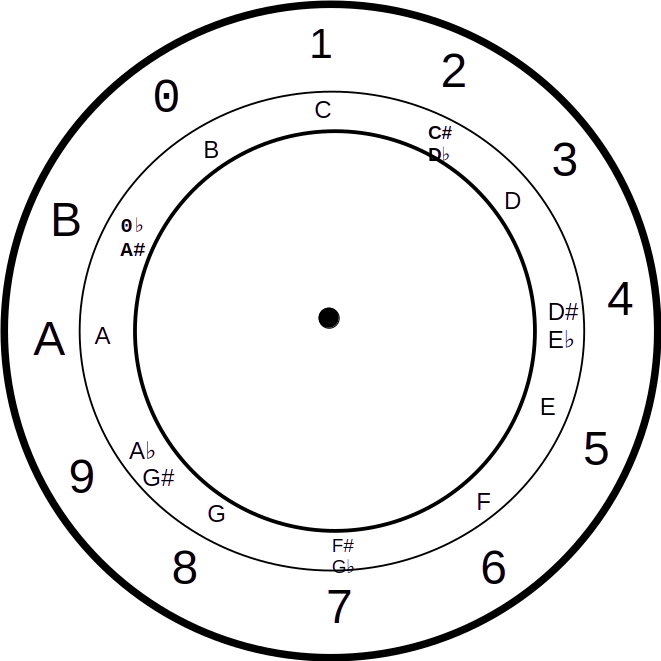
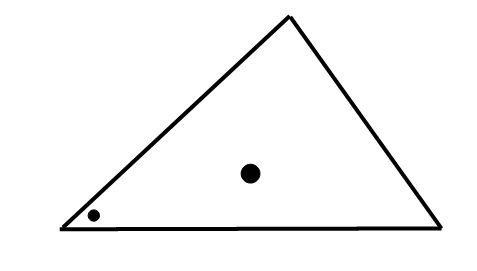
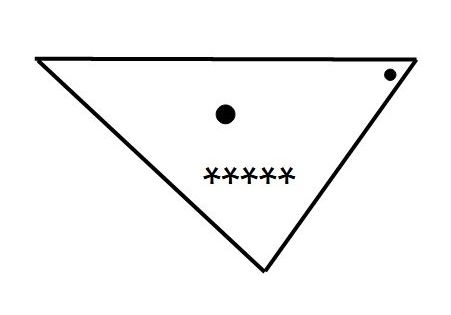
In his publication, the first note is set to C and numbered zero. The graphic he proposes consists of two triangles and a circle.
We adapted and redesigned it using our own method getting the same results. (see Appendix 1)
But the method we use – taking well-tempered music as an example of a duodecimal positional number system – has many other advantages. which we would like to discuss in more detail.
The Greeks recognized early on that there are simple harmonic relationships between sounds, and they demonstrated this through various experimental settings. They chose the upper tone of an octave as the reference tone for harmonic relationships, whereas in Western music – beginning with church music nearly a thousand years later – the lower tone of the octave was chosen as reference tone. Bach composed the *Well-Tempered-Clavier* without any mathematical basis. Later, mathematicians such as Helmholtz demonstrated that such a basis does exist and that only a slight deviation occurs starting with the third position of the frequency ratio – a deviation that can be neglected on the *Well-Tempered-Clavier*, which has 13 notes per octave and 12 tone ratios. *Well-Tempered-Music* can therefore be regarded as an ideal example of a duodecimal positional system. We have held this view for some time now (https://musicnotation.org/systems/more-notation-systems/#other) and have also explained it in detail in an overview article on our website (https://hamburgmusicnotation.com/).
Counting the notes within an octave should therefore start with the C = number 1. It is possible to start with zero and you will obtain correct results to determine chords by using the triangles, as shown in the example cited above. (https://dozenal.org/resource-hammond-chord-dialer). However, in both music and the use of number systems in general, the zero in all positional notation systems makes it possible to determine a number’s position within the system.
The example of well-tempered music illustrates that this is particularly advantageous, since 12 notes per octave form a basic unit, and it is immediately apparent that all notes of the same name are in a close mathematical relationship to one another and are always located at the same position on the keyboard.
In addition, the *Well-Tempered-Music* can be used as a simple example for practicing basic arithmetic operations such as addition, subtraction, multiplication, and division in the duodecimal system.
Systematic application of these findings would greatly simplify the learning of mathematical relationships in harmony and enable simple graphical solutions for well-tempered music.
Furthermore, the different approaches taken by Hammond and ourselves can serve as examples to illustrate the advantages of positional numeral systems.
The wheel we developed for well-tempered music, based on the duodecimal system, is better suited for learning the structure of scales, chords, and the circle of fourths and fifths than using two triangles. We will explain this in more detail in the following article.
Appendix 1: Dozenal wheel for “welltempered music“
Chord & scale dialer forConventional & Hamburg Music Notation
Dial a chord Major chords: Rotate the white triangle so that the dotted corner points to the root note and the other corners point to the other two notes. Minor chords: Rotate the ***** triangle so that the dotted corner points to the root note and the other corners point to the other two notes.
1. Cut out the white triangle, staying as close to the line as possible. 2. Cut out the ***** triangle, staying as close to the line as possible. 3. Punch holes in the circle in the center of the “Chord Dialer” sheet and in the circles of the two triangles. 4. Align the holes in the three parts in the following order: “Chord Dialer,” white triangle, ***** triangle. 5. Attach the three parts however you like; make sure they can rotate independently of one another. 6. Begin selecting chords.
A wheel for *Well-Tempered Music*by Christian Pörksen and Harry Schreiber
Numerous circular diagrams designed to help students understand musical concepts have already been developed and are available for viewing and purchase online.
After we had modified the labeling of Hammond’s circle diagram according to the principles of the place-value system, we came up with the idea of developing a simple device that would make it possible to teach musical concepts of *Well-Tempered-Music* using mathematical methods.
Our device:
A Wheel for *Well-Tempered Music*
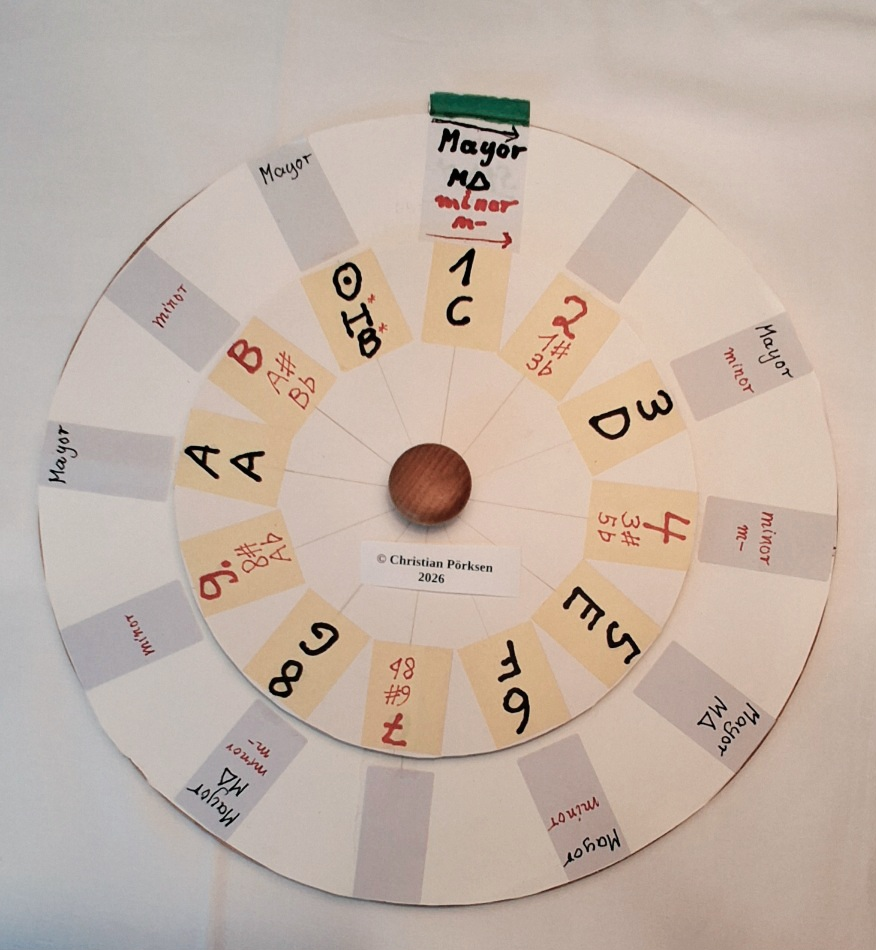
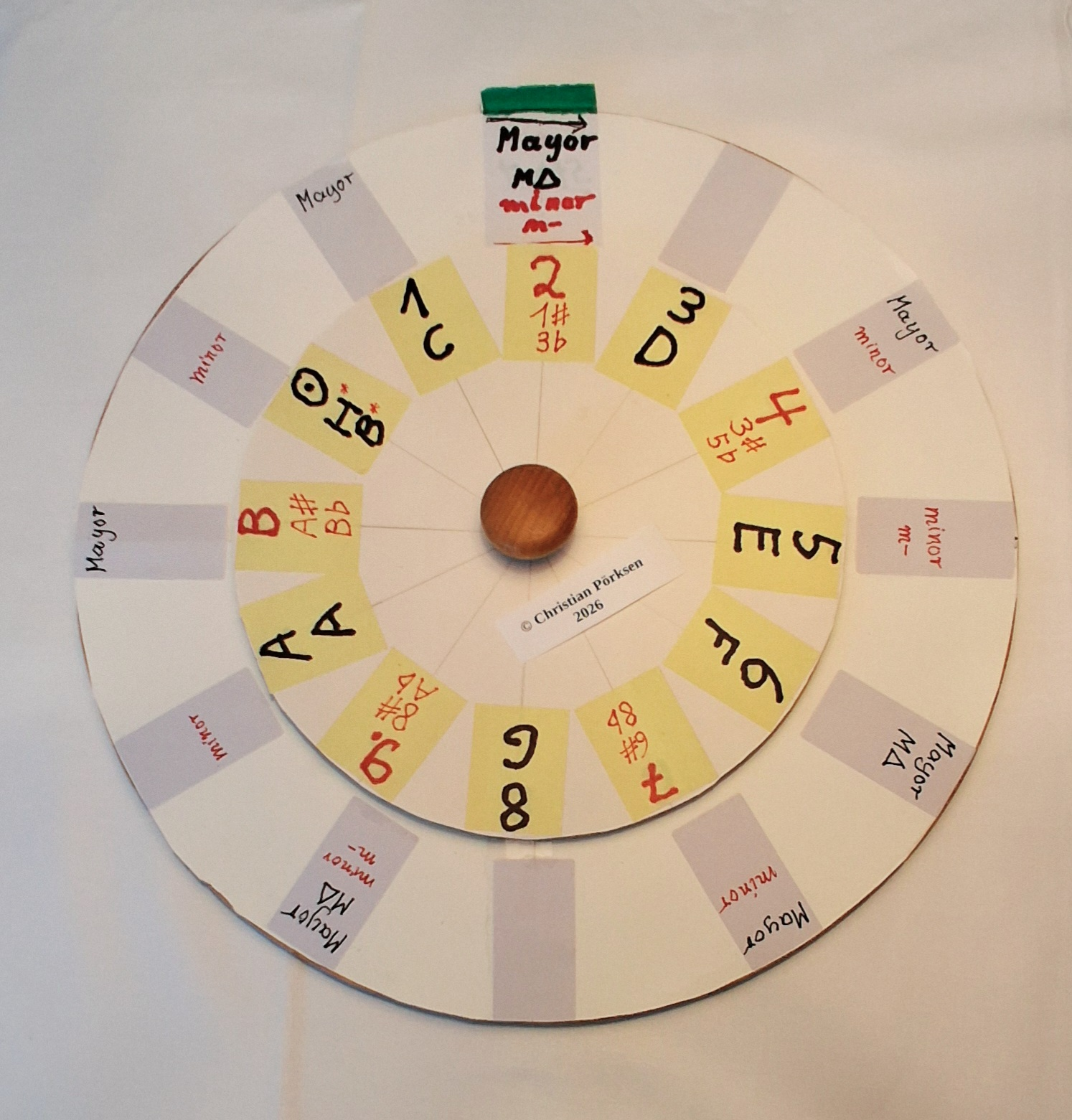
Two circular discs of different sizes were placed one on top of the other, with the upper disc able to rotate over the lower disc.
The outer edge of the upper disc was labeled with the digits of the positional duodecimal system as we use it in Hamburgmusicnotation. www.hamburgmusicnotation.com
The digits 1, 2, 3, 4, 5, 6, 7, 8, 9, and A were assigned the corresponding conventional designations for the notes in Anglo-American notation.
The eleventh decimal position – the duodecimal B – which is designated as B or ais in Germany and Sweden and as Bb (B flat) or A sharp in Anglo-American notation, is labeled B, as in the duodecimal system, which corresponds to the German and Swedish notation in musical notation and is close to the Anglo-American notation of B flat. https://en.wikipedia.org/wiki/Musical_note
The twelfth decimal position—the tenth duodecimal position, which we mark with a dot in the center to indicate the duodecimal number 10 corresponds to “B” in Anglo-American notation and to “H” in German and Swedish notation. Both letters listed on the edge of the disc are assigned according to the (1)0; the 0, marked with a dot in the center, represents the duodecimal 10th tone in our notation and, when using the duodecimal system in well-tempered music, allows us to mark the transition from one octave to the next. See also the MIDI table we have created, with its impressively simple structure of well-tempered music. https://hamburgmusicnotation.com/wp-content/uploads/2020/05/midiwertecent4.pdf
On the lower disc, a starting point has been labeled “Start” and marked in green. In the starting position, the note sequences of the C major and C minor scales and the major and minor chords for these scales can be read directly. By rotating the upper disc counterclockwise, you can now read all the numerical and verbal designations for all 12 major and minor scales and the corresponding major and minor chords. As an example, we have chosen position 2 (C-sharp major/D-flat major).
Other scales and chords can also be read directly by marking the lower disc accordingly. This principle can be applied to all defined relationships within the system of well-tempered music and can, for example, be applied to the scales commonly used in jazz as well as to the dominant seventh chord by marking the lower disc accordingly. Using numbers, everything can also be read downward without problems, starting from the high C of the scale and moving in the opposite direction, while maintaining the same harmonic principles. In ancient Greece, scales and chords were determined and notated in this way.
Discussion and summary: For all beginners who want to play jazz or freely improvised music of any kind, the benefits seem immediately apparent. That was the opinion of my trumpet teacher, Bob Lanese († 2024), when I showed the system to him. Also beginners who want to learn standard Western notation may find it helpful to learn the corresponding numbers for all notes. My second trumpet teacher, Boris Havkin, who wrote the book *Tonleiterstudien für Trompete* (*Scale Exercises for Trumpet*) https://www.stretta-music.de/havkin-tonleiterstudien-fuer-trompete-nr-485150.html in german language told me the following: „I also teach many young children and use the numbers you have chosen in addition to the standard notation. They often can’t remember the names of the accidental notes, but almost always remember the numbers assigned to them.”
His approach may make a significant contribution to music education using contemporary methods. I myself found it very helpful to simply write the corresponding number for the note to be played in front of the accidentals.
Our goal is to ensure that as many people as possible can read and write music.
Hamburg numerical music notation Hamburg Music Notation (HMN)
Christian Pörksen and Harry Schreiber Extended written version of a lecture from 29/10/22 at the symposium Music and Brain in Münster
The English version of the publication was created with the help of the translation software Deepl http://www.deepl.com/translater. Only a few manual corrections were necessary. The original German version is the reference version.
Introduction:
Our topic is concerned with the question of whether it is possible to capture well-tempered music in a mathematical number system in such a way that it can be fully grasped and communicated in a way similar to the binary or decimal number system. We quote some thoughts that the brilliant researcher and thinker Leibniz, who lived until 1715, thought and wrote down on the subject of music (1) and please consider how long it took for his invention of the binary number system (2), the basis of computer technology, to find its way into our daily lives. The introduction of the decimal system also met with considerable resistance, especially in Germany, where, on the other hand, considerable progress was made in mathematics and important open questions such as Riemann’s conjecture were formulated (3). All attempts to express music using a generally accepted number system have failed so far and have met with fierce resistance from many musicians. This is a serious problem that we also underestimated. It is very easy to understand that the 12 tones of Western music can also be named with a number or a letter or other symbols, for which there is a list on the website “The Music Notation Project Exploring Alternative Music Notation Systems” provides numerous examples and graphical representations (4). Our endeavours are also described in detail there or on our website (5). We humans are almost all so used to calculating in the decimal system that the introduction of the duodecimal system has not yet succeeded despite all efforts. Many mathematicians, especially those of the Dozenal Societies of the USA (6) and Great Britain (7), consider this system to be more suitable than the decimal system. Perhaps it will be possible to use music to establish the duodecimal system alongside the decimal system and make music accessible and understandable to all citizens as a basic element of human education – as was already demanded in ancient Greece. Like others, e.g. Tom Pendlebury (8), we try to explain in this article why we consider the duodecimal number system suitable for closing this gap. Leibniz wrote about the importance of mathematics in music (1): “Music is subordinate to arithmetic, and if you know some basic experiments with harmonies and dissonances, you know that all other principles depend on numbers”. And quoted elsewhere, but from the same overview and not from the original source: “Because the intervals we use are all composed of ratios between the prime numbers 1, 2, 3 and 5. If we were given a little more finesse, we could also include those with the prime number 7″. And I believe that this is indeed the case. That’s why the ancient world didn’t completely shy away from the number seven. But there are hardly any people who also use the intervals of the nearest prime numbers 11 and 13. I too have often thought about the question of what significance numbers, and prime numbers in particular, have for music and have asked others about this without finding a satisfactory answer.
Method:
In the following, we show that it is possible to fulfil all the requirements of the Western notation system with the help of the duodecimal system and simple graphical changes. Our own endeavours can be found in detail under (9) and are briefly described here once again. Two parameters of classical western music notation can be simplified. 1. To label the notes It was an exhilarating moment when I realised one morning in my practice room that there are only 12 notes in Western music, all of which can be given a number name and written before all the accidentals, and I still do this today, and it has made reading music in the usual treble clef notation much easier for me, as the accidentals are no longer necessary. At first I used the decimal system for labelling, but then I switched to the duodecimal system, which can be used to represent all aspects of well-tempered music and enables simple arithmetic operations within the system, which is structured in “octaves”. It was then a long road to the development of the duodecimal Hamburg Music Notation, which I called by that name because I reject the common practice of using proper names and because the name of the music city of Hamburg is memorable and was still available at the time. The Hamburg Music Notation (HMN) can also be found under the following names, all of which characterise important aspects of this system: DCMN, Emojitype, Pianotype Notation, Hamburg Numerical Music Notation. 2. To simplify the graphic The typeface can and should also be simplified. You can find our suggestions on the Internet. (5) They are: Change as little as possible. No accidentals. No additional clefs. The principle of black and white keys can be implemented using two graphically distinguishable note heads (a) normal for notes on the white keys and (b) cross as the note head for the black keys. The notes of all octaves are shown in the same position on the lines and guides. We would particularly like to draw your attention to our poster, which provides an overview of all twelve major and minor keys and the most important chords (10). The poster shows you in the centre the new representation of the 12 keys of Western music, expressed in 12 duodecimal digits and marked with six colours on the 5 usual lines. Colour coding is not absolutely essential. For comparison, the 12 major and minor keys are shown to the left and right in classical notation. There are two software approaches. One comes from the company of my Belgian partner Dominique Vandeneucker. Alternative Music Notation (11), a numerical notation that can also be converted and written in Jianpu, the numerical notation commonly used in Asia. In co-operation with the programmer Robert Ipach, the free downloadable beta version for Musescore (12) is now available, which can convert the music notation from the usual to the Hamburg music notation with one click. This version can only be used in Musescore 3. Anyone interested in the subject can study numerous suggestions from music enthusiasts at http://www.musicnotation.org (18).
Discussion:
We fully agree with the following quote: “Bach’s compositional work “The Well-Tempered Clavier” (13), in which he created scores for all 12 major and minor keys on the basis of Werckmeister’s work (14) for the tuning of the piano with 12 keys, was a great help for the further development of composition and music-making. Bach treated all keys equally, according to the “compositional principles” he had essentially developed on his own. We have so many languages in the world and the lingua franca (15) of our day is undoubtedly the English language. Music is a universal language (16), but a lingua franca for music does not exist – indeed, music has largely remained stuck at the level of oral tradition in terms of its communication. But a lingua franca for music is urgently needed, because without definitions of the languages of music – its letters and its syntax – we will never be able to communicate adequately. In the Wikipedia article musical literacy (17) a figure of only around 9 per cent of the world’s population being able to read and write music is mentioned. This article also discusses many aspects and new insights into the reasons why music has largely remained stuck in the oral tradition. On 29 October 2022, a conference on the subject of music and the brain was held at the Physiological Institute of the University of Münster under the direction of Erwin-Josef Speckmann and Klaus von Wild, at which I was given the opportunity to present the music notation we have developed under the title given above. The content of this presentation forms the basis of this publication. On my website (5) and on the pages of musicnotation.org (18) you will find several descriptions of this by my co-author Harry Schreiber and myself. These deal with the endeavours to make music easier to read and have taken the endeavours of Read (19) as a basis for evaluation, even if we do not agree with all the requirement criteria there. The chapter Applications for the Duodecimal System of the Dozenal Society of Great Britain contains the article by Tom Pendlebury (20) and a reference to our representations:n”Hamburger Musik Notation, the description of a new notation for music by Christian Pörksen”: Next to the clock, well-tempered music is probably the most common practical application of the duodecimal principle currently in use. Please download the pdf file with our ideas (21). Firstly, we comment on the article on the homepage of the DSGB (“Dozenal Society of Great Britain”, title: Music á la Dozen, Chapter Applications, title: Music, Scales (20) Author: Tom Pendlebury, who deserves special mention here. This Englishman and dozenalist emphasised and justified the importance of the duodecimal system for music, but unfortunately died before he could complete his remarks. I was therefore no longer able to ask him why he labelled the first note of an octave(C) of the keyboard with zero and not with 1. I am also grateful to the Dozenal Society of America (6) for the following statement in Vol. 05, Iss. 06: In “The official newsletter of the Dozenal Society of America 1 September 1201″ (decimal converted 2017), Dr John Impagliazzo wrote: Music lovers have long been interested in the duodecimal system; beginning with Vodjevetz’s new music notation, the application of the duodecimal system to music has been an ongoing concern. You may therefore be interested to learn about Hamburg music notation: Based on the observation that an “octave” consists of twelve semitones and an “octave” comprises twelve semitones, notes are represented as numerical values in Hamburg notation. Very interesting and worth a look for those who are familiar with such things. Dr John Impagliazzo has written extensively on well-tempered music and scales in duodecimal notation (22). Well-tempered music can be described mathematically using the duodecimal position number system (23). This approach enables the development of suitable software. There is currently a beta version of an add-on for Musescore 3 available for free download from Robert Ipach with our support (12), which enables notes to be converted to HMN. The name of the notes in the text lines below the note image can also be displayed. Unfortunately, the music cannot yet be played after conversion, as there are still some errors. Unfortunately, we currently lack the financial resources to further improve and market the free software. We are convinced that learning notation is much easier simply by labelling the notes with a number as a name. My teacher, solo trumpeter Boris Havkin (25), has had very good experiences with this in his many years of teaching beginners. We have only slightly modified the duodecimal addition and multiplication table (Fig. 1) from 1-100 from Wikipedia in order to illustrate many aspects of music where the use of simple arithmetic operations are helpful. Fig. 1 Duodecimal multiplication table
This means that not only the scales but also the circle of fourths, circle of fifths and Bb circle (circle of elevenths) can be easily mapped by addition and subtraction (Fig. 2). The term circle is actually not a good term, as the notes are played upwards and downwards and it would be better to think of a ladder that you can go up and down or play. It is then possible to give each playable note a number that clearly identifies it. However, such serious changes can only be realized with a major international effort aimed at introducing the duodecimal system into twelve-tone music. The structuring of the keyboard into blocks of 10 (decimal 12) keys each results in a clear organisation. The prime number steps play a special role here. The semitone steps are counted: The scale of fourths up and down follows +5 or-5 from each note. The scale of fifths up and down follows +7 or-7 from each note. The eleventh (Bb) scale up and down follows +B or -B from each note. The system of chords (see Fig. 2) can also be easily represented and learnt in the duodecimal system and could replace the current complex system, which is only well mastered by a few. All aspects of Western music can be represented mathematically. This also applies to all other musical systems with equal temperament (24).
Fig.2 Prime number steps (5,7,B) are marked. Duodecimal multiplication table modified for music
For the sake of clarity, this illustration does not include a translation of the German nomenclature.
We return to the starting point of our considerations and now essentially limit ourselves to so-called Western music, whose development was given such a decisive boost by the genius Johann Sebastian Bach with his publication “The Well-Tempered Clavier” (13). We transferred Bach’s ideas to the naming and position of the notes. Wikipedia explains in detail why numbering systems make sense. (23) Each of the twelve tones only needs one name to identify it. Starting with C=1, the duodecimal system is used as Positional numeral system used in the sequence 1,2,3,4,5,6,7,8,9,A,B,10. Different symbols are used for ten and eleven in duodecimal notation; we use A and B as in Wikipedia English, as in hexadecimal notation, so that a duodecimal count from zero to twelve is 0, 1, 2, 3, 4, 5, 6, 7, 8, 9, A, B, 10. The marking of the zero with a dot in the centre (0) in the duodecimal system is a separate proposal and is available as a special character or directly available in the Liberation Mono font. In the following, we use both designations in parallel. Decimal 1 2 3 4 5 6 7 8 9 10 Duodecimal 1 2 3 4 5 6 7 8 9 A B 10 We designate the decimal tenth position as A in duodecimal, the eleventh as B and the duodecimal tenth as 10 and use a zero with a dot in the centre to distinguish it from the decimal ten. Music is divided into octaves, and the major and minor scales are the most commonly used scales. These consist of eight notes. It is important to note the following: the 8th note of a scale is also the first note of the next higher scale. The connection is easier to understand if we start from twelve-tone music. In this case, the octave tone is already the 13th tone decimal and therefore the eleventh duodecimal tone. After ten duodecimal multiplication steps or addition steps with the same digit, we return to the starting number and the eleventh duodecimal tone is therefore both the end point of the octave and the starting point of the next higher octave. Although the octave tone sounds similar to the original tone, it is a completely new tone with different overtones and undertones and a doubling of the original frequency. Each initial tone of an octave begins its own tonal world. If we transpose a composition into a different key, this measure can greatly change the sound. Fig. 3 below shows you how each octave can be organised mathematically using the note 5 (E) as an example. It is also suitable for practising all scales and chords for a specific pitch. Fig.(3) Exercise table for addition and subtraction shown in duodecimal: Positions and range of the 10 ascending and descending intervals of all scales using the example of tone 5=E as the base tone. The prime number intervals are emphasised +/-5 semitones = (fourth), +/- 7 semitones = (fifth) and +/- B (dec.11) semitones.
The circle of fourths, fifths and Bb can be read directly for each key from the duodecimal addition table by adding the prime numbers 5, 7 and B (11 decimal), and we recognise how the octaves can be divided into ladders instead of circles, and that we should abandon the image of the circle as an auxiliary number construction. For the prime numbers 5, 7 and B (decimal 11), they repeat after every 10 (decimal 12) steps, and of course this also applies to every other note. After 10 duodecimal steps, the next octave begins again with the starting number on the scale-just one duodecimal step or one octave higher.
Summary:
Human communication via sounds or complex music are probably the most frequently used languages of mankind. It is time to develop suitable, easy-to-learn written languages for them.
Only in this way can the prevailing musical illiteracy be eliminated and the full potential of this means of communication be realised. When Martin Luther translated the Bible into German, the world changed for many people. Something similar could happen if we humans could find a lingua franca for music that is generally accepted. We are convinced that the establishment of the duodecimal system in music by “well-tempering” the nomenclature of the notes can take over this task for the notes and that simple graphical solutions are possible by using two types of note heads based on the model of a conventional keyboard, as we have shown. The vehicle of this simple musical written language could also be used to establish the duodecimal place value system as another basis of practical mathematics.
List of illustrations:
Fig.1 Duodecimal multiplication table Fig.2 Duodecimal multiplication table modified for music
Fig.3 Octave-specific addition and multiplication table