
Christian Pörksen, Harry Schreiber *Well-Tempered-Music* an example of a Duodecimal Positional Number System
This is a letter we sent to the Dozenal Society of America. https://dozenal.org/
Hammond (https://dozenal.org/resource-hammond-chord-dialer) suggested using a circle and two triangles to identify the major and minor chords of the chromatic scale.
In his publication, the first note is set to C and numbered zero.
The graphic he proposes consists of two triangles and a circle.
We adapted and redesigned it using our own method getting the same results. (see Appendix 1)
But the method we use – taking well-tempered music as an example of a duodecimal positional number system – has many other advantages. which we would like to discuss in more detail.
The Greeks recognized early on that there are simple harmonic relationships between sounds, and they demonstrated this through various experimental settings.
They chose the upper tone of an octave as the reference tone for harmonic relationships, whereas in Western music – beginning with church music nearly a thousand years later – the lower tone of the octave was chosen as reference tone. Bach composed the *Well-Tempered-Clavier* without any mathematical basis. Later, mathematicians such as Helmholtz demonstrated that such a basis does exist and that only a slight deviation occurs starting with the third position of the frequency ratio – a deviation that can be neglected on the *Well-Tempered-Clavier*, which has 13 notes per octave and 12 tone ratios. *Well-Tempered-Music* can therefore be regarded as an ideal example of a duodecimal positional system. We have held this view for some time now (https://musicnotation.org/systems/more-notation-systems/#other) and have also explained it in detail in an overview article on our website (https://hamburgmusicnotation.com/).
Counting the notes within an octave should therefore start with the C = number 1.
It is possible to start with zero and you will obtain correct results to determine chords by using the triangles, as shown in the example cited above. (https://dozenal.org/resource-hammond-chord-dialer). However, in both music and the use of number systems in general, the zero in all positional notation systems makes it possible to determine a number’s position within the system.
The example of well-tempered music illustrates that this is particularly advantageous, since 12 notes per octave form a basic unit, and it is immediately apparent that all notes of the same name are in a close mathematical relationship to one another and are always located at the same position on the keyboard.
In addition, the *Well-Tempered-Music* can be used as a simple example for practicing basic arithmetic operations such as addition, subtraction, multiplication, and division in the duodecimal system.
Systematic application of these findings would greatly simplify the learning of mathematical relationships in harmony and enable simple graphical solutions for well-tempered music.
Furthermore, the different approaches taken by Hammond and ourselves can serve as examples to illustrate the advantages of positional numeral systems.
The wheel we developed for well-tempered music, based on the duodecimal system, is better suited for learning the structure of scales, chords, and the circle of fourths and fifths than using two triangles. We will explain this in more detail in the following article.
Appendix 1: Dozenal wheel for “welltempered music“
Chord & scale dialer for Conventional & Hamburg Music Notation
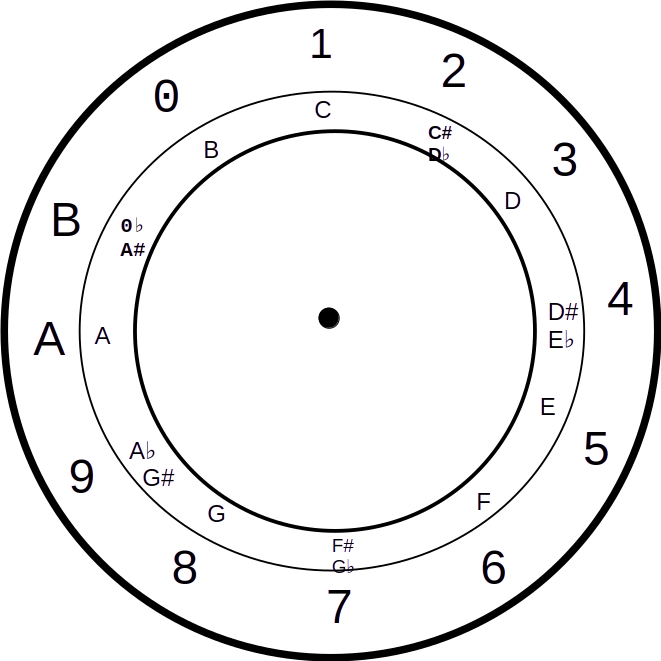
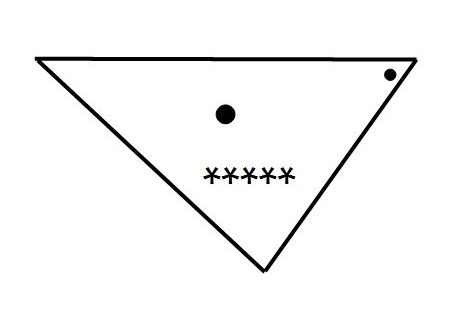
| Dial a chord Major chords: Rotate the white triangle so that the dotted corner points to the root note and the other corners point to the other two notes. Minor chords: Rotate the ***** triangle so that the dotted corner points to the root note and the other corners point to the other two notes. |
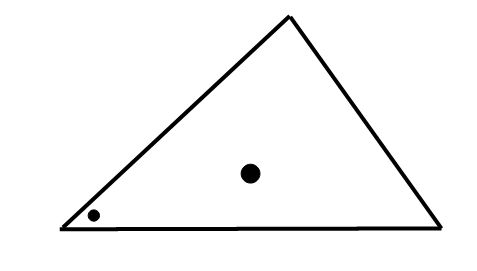
1. Cut out the white triangle, staying as close to the line as possible.
2. Cut out the ***** triangle, staying as close to the line as possible.
3. Punch holes in the circle in the center of the “Chord Dialer” sheet and in the circles of the two triangles.
4. Align the holes in the three parts in the following order: “Chord Dialer,” white triangle, ***** triangle.
5. Attach the three parts however you like; make sure they can rotate independently of one another.
6. Begin selecting chords.
A wheel for *Well-Tempered Music* by Christian Pörksen and Harry Schreiber
Numerous circular diagrams designed to help students understand musical concepts have already been developed and are available for viewing and purchase online.
After we had modified the labeling of Hammond’s circle diagram according to the principles of the place-value system, we came up with the idea of developing a simple device that would make it possible to teach musical concepts of *Well-Tempered-Music* using mathematical methods.
Our device:
A Wheel for *Well-Tempered Music*
Two circular discs of different sizes were placed one on top of the other, with the upper disc able to rotate over the lower disc.
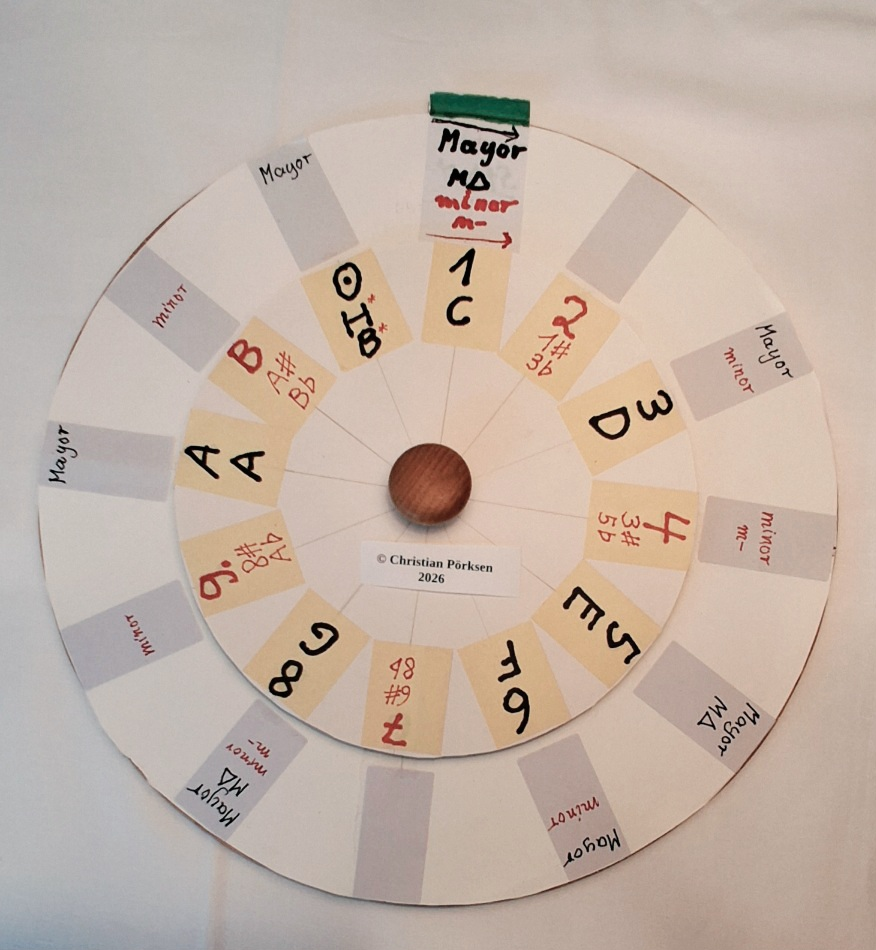
The outer edge of the upper disc was labeled with the digits of the positional duodecimal system as we use it in Hamburgmusicnotation. www.hamburgmusicnotation.com
The digits 1, 2, 3, 4, 5, 6, 7, 8, 9, and A were assigned the corresponding conventional designations for the notes in Anglo-American notation.
The eleventh decimal position – the duodecimal B – which is designated as B or ais in Germany and Sweden and as Bb (B flat) or A sharp in Anglo-American notation, is labeled B, as in the duodecimal system, which corresponds to the German and Swedish notation in musical notation and is close to the Anglo-American notation of B flat. https://en.wikipedia.org/wiki/Musical_note
The twelfth decimal position—the tenth duodecimal position, which we mark with a dot in the center to indicate the duodecimal number 10 corresponds to “B” in Anglo-American notation and to “H” in German and Swedish notation. Both letters listed on the edge of the disc are assigned according to the (1)0; the 0, marked with a dot in the center, represents the duodecimal 10th tone in our notation and, when using the duodecimal system in well-tempered music, allows us to mark the transition from one octave to the next. See also the MIDI table we have created, with its impressively simple structure of well-tempered music. https://hamburgmusicnotation.com/wp-content/uploads/2020/05/midiwertecent4.pdf
On the lower disc, a starting point has been labeled “Start” and marked in green.
In the starting position, the note sequences of the C major and C minor scales and the major and minor chords for these scales can be read directly. By rotating the upper disc counterclockwise, you can now read all the numerical and verbal designations for all 12 major and minor scales and the corresponding major and minor chords. As an example, we have chosen position 2 (C-sharp major/D-flat major).
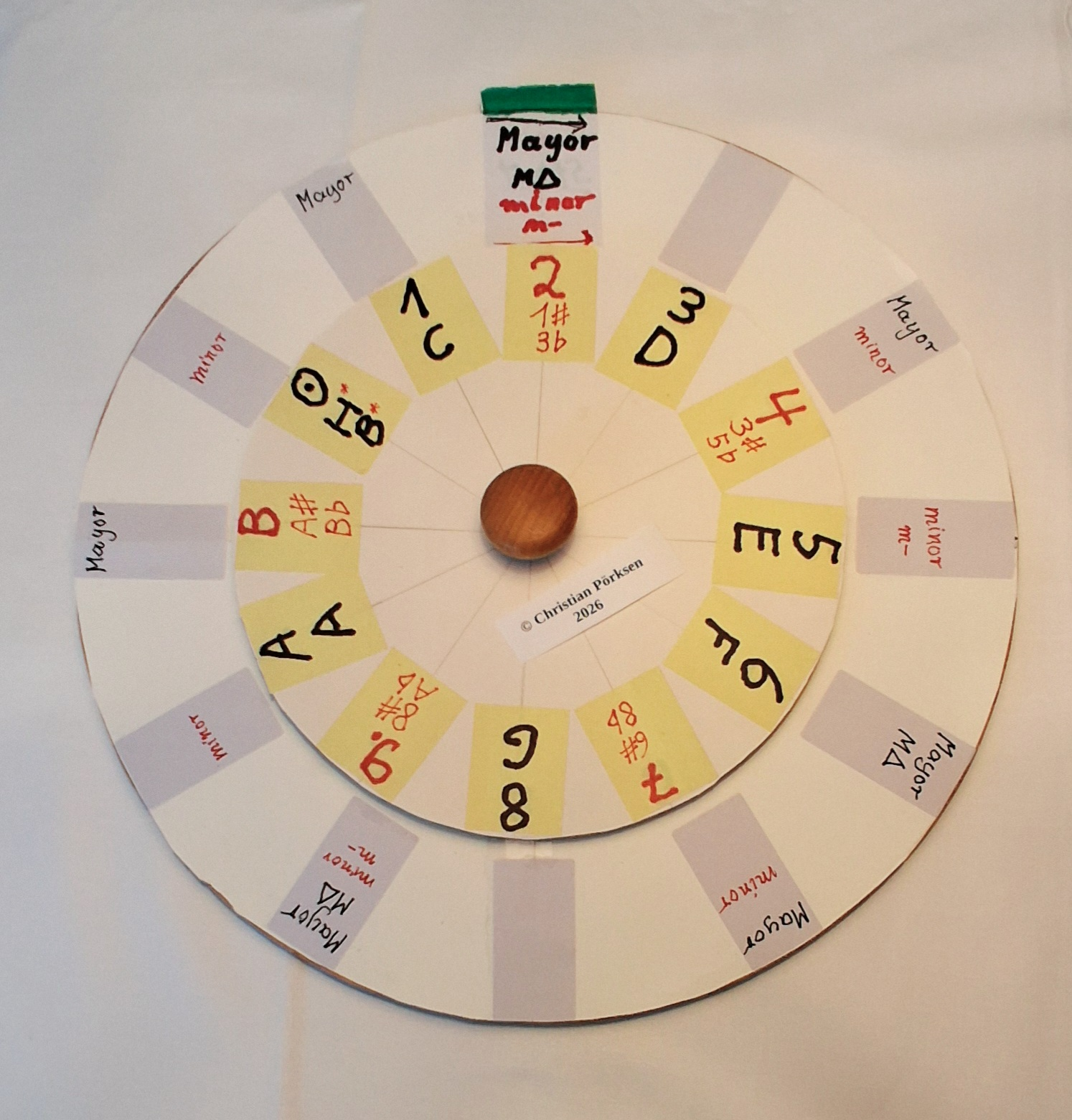
Other scales and chords can also be read directly by marking the lower disc accordingly.
This principle can be applied to all defined relationships within the system of well-tempered music and can, for example, be applied to the scales commonly used in jazz as well as to the dominant seventh chord by marking the lower disc accordingly. Using numbers, everything can also be read downward without problems, starting from the high C of the scale and moving in the opposite direction, while maintaining the same harmonic principles. In ancient Greece, scales and chords were determined and notated in this way.
Discussion and summary:
For all beginners who want to play jazz or freely improvised music of any kind, the benefits seem immediately apparent. That was the opinion of my trumpet teacher, Bob Lanese († 2024), when I showed the system to him. Also beginners who want to learn standard Western notation may find it helpful to learn the corresponding numbers for all notes. My second trumpet teacher, Boris Havkin, who wrote the book *Tonleiterstudien für Trompete* (*Scale Exercises for Trumpet*) https://www.stretta-music.de/havkin-tonleiterstudien-fuer-trompete-nr-485150.html in german language told me the following: „I also teach many young children and use the numbers you have chosen in addition to the standard notation. They often can’t remember the names of the accidental notes, but almost always remember the numbers assigned to them.”
His approach may make a significant contribution to music education using contemporary methods. I myself found it very helpful to simply write the corresponding number for the note to be played in front of the accidentals.
Our goal is to ensure that as many people as possible can read and write music.

